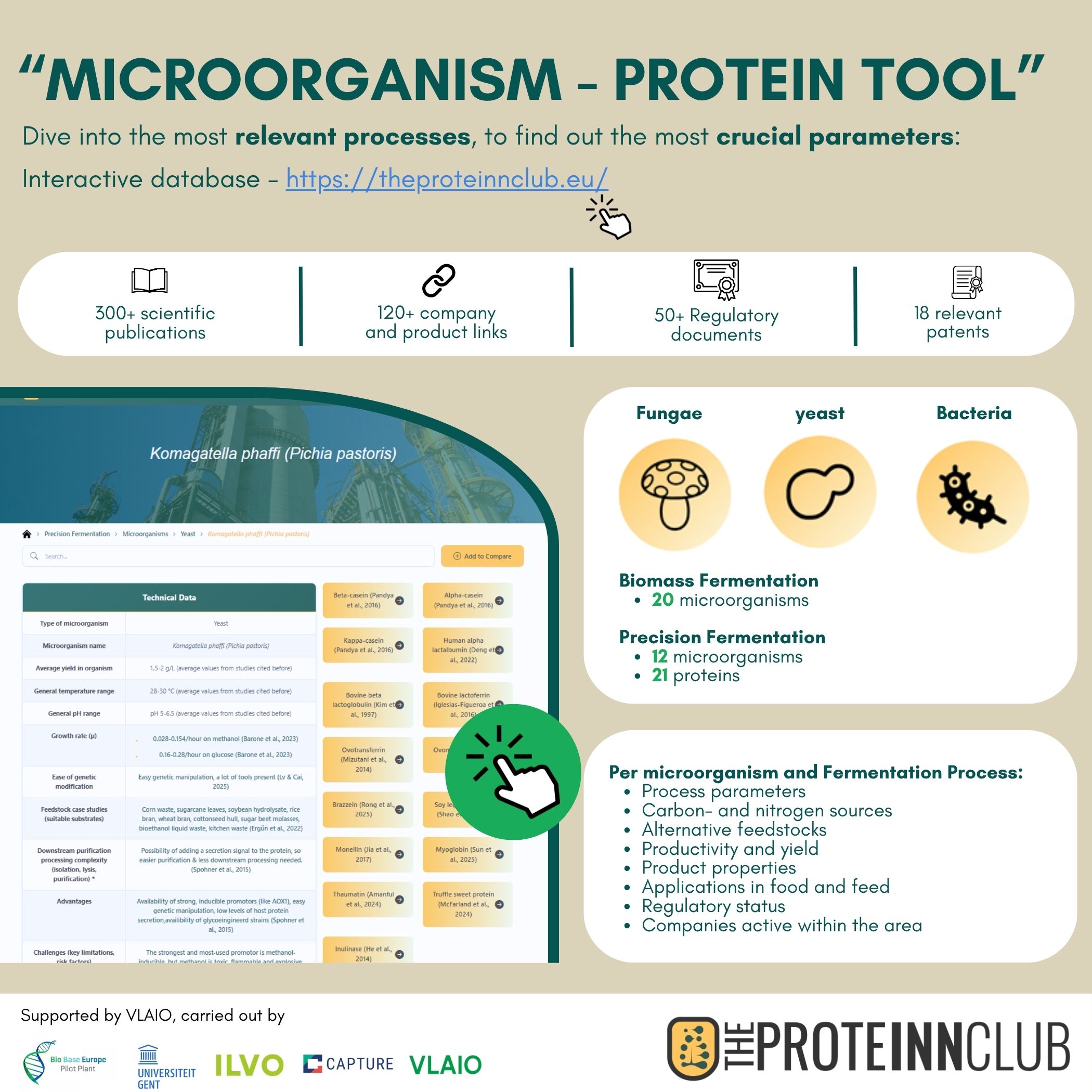
Which microorganisms are best suited to produce single-cell protein, casein, ovalbumin, myoglobin,… or other high value proteins? How productive are these fermentation processes? What protein yields can be achieved from a given carbon source, have alternative feedstocks been explored, and which final protein concentrations are reached? What is their regulatory status, and which companies are already working with them?
Anyone looking for answers to these questions will find a wealth of information, but scattered across hundreds of scientific publications, patents, regulatory documents, and company websites. The ProteInn Club has brought this fragmented knowledge together in one accessible, searchable “Microorganism-Protein Tool”.
Looking for the right microorganism? Now available in one convenient database
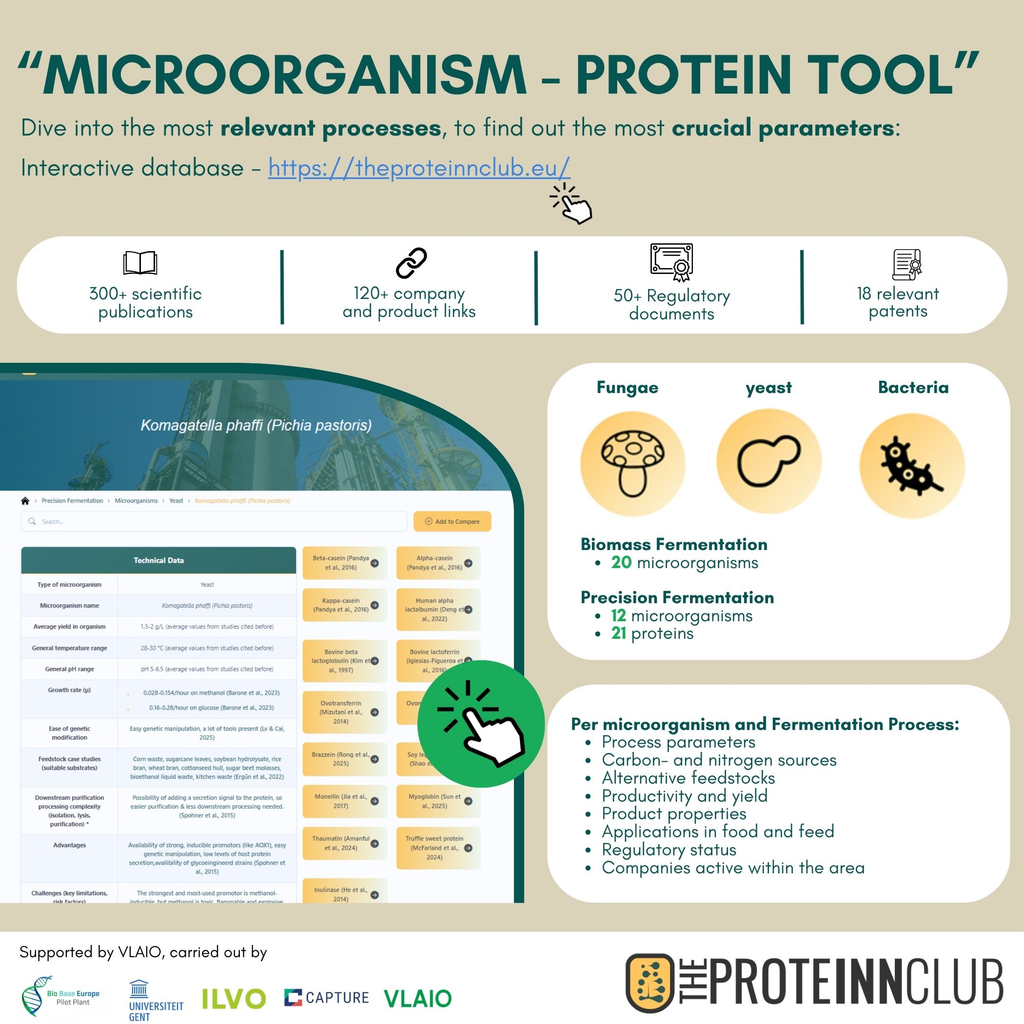
A targeted literature review mapped the most relevant fermentation processes for the production of single-cell protein through biomass fermentation and specific target proteins through precision fermentation, covering processes from laboratory to pilot and industrial scale. Publicly available data was systematically reviewed, compared, and compiled. For biomass fermentation, the tool covers 20 industrially relevant microorganisms worth exploring. For precision fermentation, it includes 12 prominent host microorganisms used to produce 21 different target proteins.
For each microorganism and process, the tool provides key information on process parameters, carbon and nitrogen sources, alternative feedstocks, productivity and yields, product characteristics, food and feed applications, regulatory status, and companies active in production. Every data point is linked to its original source.
Compare processes, yields and applications in just a few clicks
For each microorganism and fermentation process, the tool provides detailed information on:
- process parameters;
- carbon and nitrogen sources;
- alternative feedstocks;
- productivity and yields;
- product characteristics;
- food and feed applications;
- regulatory status;
- companies active in the respective field.
Each data point is directly linked to its original source, allowing users to quickly access the underlying scientific or technical information.
More than 300 sources brought together in one knowledge platform
In total, the tool guides users to more than 300 scientific publications, 120 company and product links, 50 regulatory documents, and 18 patents. By making this extensive body of knowledge searchable and comparable, it provides scientists and companies with a practical starting point to explore, benchmark, develop, and scale fermentation processes.
Exploring opportunities together
Have additional questions, feedback, or a specific challenge to explore? Get in touch with The ProteInn Club team to discuss your needs and explore the opportunities for your fermentation process together. Contact: TheProteInnClub.eu.
Acknowledgements
We thank VLAIO for supporting the Ferm Eiwit project, which enabled The ProteInn Club to carry out this study. Special thanks go to the thesis student Lukas Pieters who contributed to the literature review, under the supervision of Julie Vanderstraeten (Bio Base Europe Pilot Plant), and to the thesis student Leander Roelandt who designed and developed the interactive tool, under the supervision of Samuel Bosch (ILVO).